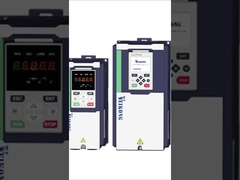
Brief: Stay tuned as we highlight the most important features and real-use results. In this video, we demonstrate how the VEIKONG 355KW AC motor drive performs as a reliable replacement for ABB drives. You'll see a detailed walkthrough of its high-speed accuracy, wide speed range, and robust overload capabilities in various industrial applications.
Related Product Features:
High speed accuracy with steady speed accuracy of ±0.5% (SVC) and ±0.02% (VC) for precise motor control.
Wide speed range from 1:200 (SVC) to 1:1000 (VC) suitable for diverse industrial requirements.
Heavy load overload capability supporting 110% rated current long-term, 150% for 1 minute, and 180% for 10 seconds.
High torque in low speed with up to 200% load capacity at 0Hz in VC mode for demanding start-ups.
Multiple control modes including V/f control, sensorless flux vector control (SVC), and sensor speed flux vector control (VC).
Integrated communication interfaces with standard MODBUS and optional CAN OPEN and PROFINET for seamless connectivity.
Robust environmental tolerance operating from -10°C to +40°C and altitudes up to 3000m with proper derating.
Comprehensive protection features and EMC compliance with CE and ROHS certifications for safe and reliable operation.
FAQs:
What are the key advantages of using VEIKONG variable frequency inverters for AC motor equipment?
VEIKONG inverters offer high speed accuracy (±0.5% SVC, ±0.02% VC), wide speed ranges (1:200 SVC, 1:1000 VC), and exceptional overload capabilities (110% continuous, 150% for 1 minute). They provide high torque at low speeds and fast response to impact loads, making them ideal for demanding industrial applications.
What communication protocols are supported by these variable frequency inverters?
These inverters support standard MODBUS communication via RS485. Additionally, CAN OPEN and PROFINET protocols are currently in development, providing flexible connectivity options for various industrial automation systems.
How do these inverters handle different environmental conditions during operation?
The inverters are designed for indoor use with operating temperatures from -10°C to +40°C (derated up to 50°C) and altitudes up to 3000m. They feature protection against dust, corrosive gases, and vibration while maintaining EMC compliance with CE and ROHS certifications.
What control modes are available for motor speed regulation?
Three control modes are available: V/f control for basic applications, sensorless flux vector control (SVC) for improved performance without encoders, and sensor speed flux vector control (VC) for high-precision applications requiring encoder feedback.