












logo
Solutions
0+
Countries worldwide
0+
Partners
0+
Patents
0+
Employees
Company events
A Guide to VFD Installation: Avoid These Pitfalls to Maximize Lifespan A Guide to VFD Installation: Avoid These Pitfalls to Maximize Lifespan VFDs are the heart of modern motor control systems, delivering energy savings and precise speed regulation. However, even the highest-quality VFD can suffer premature failure if installation details are overlooked. At VEIKONG, we engineer our VFDs for reliability, but proper installation is the key to unlocking their full lifespan. This guide walks you through the most common installation pitfalls and how to avoid them.    1. Environmental Pitfalls: Location Matters More Than You Think   The installation environment directly impacts VFD longevity. Many users underestimate how critical this is.    The "Sauna" Effect: Temperature Control The Pitfall: Installing VFDs in high-temperature environments without adequate ventilation. Why It Matters: Temperature is the single biggest factor affecting electronic component life. For every 10°C rise in ambient temperature, the lifespan of a VFD's electrolytic capacitors is cut in half. Most VEIKONG VFDs are rated for operation up to 50°C without derating. Beyond that, you must either derate the unit or provide forced cooling.                               The Fix: - Ensure at least 10cm of clearance on top and bottom for proper airflow - Install cooling fans or air conditioning in enclosed cabinets - For IP55-rated VEIKONG VFD510 series units, the sealed design protects against dust but still requires adequate heat dissipation    Dust, Oil, and Moisture The Pitfall: Exposing VFDs to harsh environments without proper protection. Why It Matters: Dust accumulation acts as insulation, trapping heat. Conductive dust can cause short circuits. Moisture leads to corrosion, contact issues, and insulation breakdown.   The Fix: - For dusty or oily environments, choose IP55-rated units like the VEIKONG VFD510 series, specifically designed for such conditions - If using standard IP20 units, install them in a clean, sealed cabinet - Regularly clean filters and inspect for dust buildup    Vibration The Pitfall: Mounting VFDs on vibrating equipment like punch presses or industrial washing machines without isolation. Why It Matters: Vibration is a primary cause of mechanical damage to electronic components. Loose terminal screws from vibration are often the culprit behind module failures.   The Fix: - Use rubber vibration dampers or isolation mounts - Regularly torque main circuit connections (refer to VEIKONG manual for torque specifications) - Avoid mounting directly on heavy vibrating machinery    2. Wiring Pitfalls: Small Mistakes, Big Consequences   Proper wiring is non-negotiable. A seemingly minor error can destroy your VFD instantly.    Input vs. Output: Never Confuse Them The Pitfall: Connecting input power to output terminals (U, V, W). Why It Matters: This is catastrophic. Applying AC power to the output terminals will instantly destroy the IGBT module and internal circuitry.   The Fix: - Double-check: Input terminals are R/L1, S/L2, T/L3 (or L1, L2, L3) - Output terminals are U, V, W - VEIKONG manuals clearly label these—always verify before powering on    Cable Length and Output Reactors The Pitfall: Running long motor cables without output filtering. Why It Matters: Long cables increase capacitive leakage current, which can cause overcurrent trips, insulation stress, and reflected wave damage to motor windings.   The Fix: - < 50 meters: No additional filtering required for most installations - 50–100 meters: Install an output reactor - > 100 meters: Use a sine wave filter and reduce carrier frequency - VEIKONG VFDs support up to 500 meters of shielded cable with proper filtering    Grounding: The Most Overlooked Protection The Pitfall: Improper or missing ground connections. Why It Matters: A real-world case study shows a facility losing over a dozen VFDs simultaneously because a motor leaked current and the facility ground had corroded, sending high voltage back through the VFD ground and destroying main boards.   The Fix: - Always connect the VFD ground terminal (PE) to a true earth ground - Use a dedicated ground bus where possible - Verify ground resistance is less than 1Ω for sensitive applications - Do not share ground wires with high-noise equipment like welders    Power Factor Correction Capacitors The Pitfall: Installing power factor correction capacitors on the output side of the VFD. Why It Matters: This is a common but critical error. The VFD's PWM output will cause capacitors to draw excessive charging currents, leading to immediate overcurrent trips or catastrophic failure.   The Fix: - Install power factor correction on the input side of the VFD only - Use AC reactors for power factor improvement when needed   ---    3. Component Selection Pitfalls: Don't Skimp on Safety    Circuit Breaker (MCCB) Selection The Pitfall: Using an undersized or oversized circuit breaker. Why It Matters: Without proper short-circuit protection, a module failure can cascade into a full board replacement. Conversely, a breaker that's too sensitive will nuisance trip.   The Fix: - Follow VEIKONG's recommended MCCB and contactor ratings - Example: For VFD510-2R2-T4B, use a 10A MCCB and 0.75mm² conductor - Always include a circuit breaker on the input side    Braking Resistor Wiring The Pitfall: Connecting the braking resistor directly to the DC bus terminals (+/PB or +/-) incorrectly. Why It Matters: Miswiring can cause fire or drive damage.   The Fix: - Connect braking resistor to the designated terminals (typically (+) and PB) - Never connect the braking resistor directly between DC bus (+) and (-)—this bypasses the braking transistor - For VEIKONG VFD510 series, refer to the wiring diagram in Chapter 3 of the manual    4. Parameter Setting Pitfalls: The Invisible Installation   Installation isn't just physical—parameter configuration is part of the setup.    Acceleration/Deceleration Time The Pitfall: Setting acceleration or deceleration times too short for the load. Why It Matters: Too short an acceleration time causes overcurrent trips. Too short a deceleration time without a braking resistor causes overvoltage trips as regenerative energy pumps up the DC bus.   The Fix: - Start with longer times (e.g., 20–30 seconds) and gradually reduce - For high-inertia loads, use a braking resistor or extend decel time - Adjust based on actual operation, not theoretical calculations    Motor Parameters The Pitfall: Not entering correct motor nameplate data. Why It Matters: Vector control relies on accurate motor parameters. Incorrect values lead to poor torque control, instability, or overcurrent issues.   The Fix: - Enter motor rated current, voltage, frequency, and speed from the nameplate - Perform motor auto-tuning (static or dynamic) for optimal performance - VEIKONG VFDs support both static and dynamic tuning for precise control    5. Maintenance Pitfalls: Out of Sight, Out of Mind    Cooling Fans The Pitfall: Never cleaning or replacing cooling fans. Why It Matters: Cooling fans are consumable components. When they fail, the VFD overheats, shortening capacitor life and potentially causing thermal shutdown.   The Fix: - Inspect fans every 6–12 months - Replace every 3–5 years or when unusual noise occurs - VEIKONG drives provide fan status monitoring options    Capacitor Maintenance The Pitfall: Not reforming capacitors after long-term storage. Why It Matters: Electrolytic capacitors degrade if left without power for extended periods (over 2 years). Applying full voltage immediately can cause failure.   The Fix: - For VFDs stored more than 2 years, use a variable transformer to slowly apply power over several hours - If storage is uncertain, contact VEIKONG technical support for guidance    Terminal Tightness The Pitfall: Failing to periodically torque main circuit terminals. Why It Matters: Thermal cycling loosens connections over time, causing arcing, overheating, and eventual failure.   The Fix: - Check and retorque main circuit connections annually - Use the torque specifications from the VEIKONG manual - For VFD510 series, follow the tightening torque table in Chapter 3    Conclusion: Installation Is Prevention   The difference between a VFD that lasts 10 years and one that fails in 12 months often comes down to installation details. By avoiding these common pitfalls—environmental neglect, improper wiring, incorrect component selection, poor parameter settings, and maintenance oversight—you protect your investment and ensure reliable operation.   VEIKONG VFDs are built for durability, with features like IP20 protection, robust IGBT designs, and comprehensive protection functions. But even the best equipment needs proper installation. When in doubt, consult the VEIKONG user manual or contact our technical support team—we're here to help your drives run for years to come.   Related words: VFD High-performance AC drives Intelligent variable speed drives
2026-03-31 16:18:48 More >
How to Choose the Right VFD Capacity for Your Motor? A Sizing Guide How to Choose the Right VFD Capacity for Your Motor? A Sizing Guide Selecting the correct Variable Frequency Drive (VFD) capacity is critical for ensuring optimal motor performance, energy efficiency, and equipment longevity. An undersized VFD may cause frequent overload trips or premature failure, while an oversized unit leads to unnecessary capital expenditure. At VEIKONG, we specialize in providing high-performance VFDs tailored to your application needs. This guide walks you through the key considerations for VFD sizing.    1. Understand the Load Type   Before selecting a VFD, identify your motor load characteristics:   - Constant Torque Loads: Conveyors, cranes, extruders, and positive displacement pumps. These require consistent torque across the speed range. For these applications, the VFD must be selected based on the motor’s rated current with a 150% overload capacity for 60 seconds (typical for VEIKONG VFD500/VFD580 series) . - Variable Torque Loads: Centrifugal fans, pumps, and blowers. Torque increases with the square of speed. For these, a VFD with 120% overload capacity for 60 seconds is often sufficient, allowing for potential downsizing compared to constant torque applications . - Constant Power Loads: Machine tools, winders. These require special attention as torque decreases when speed increases.    2. Match VFD Current, Not Just Power   A common mistake is sizing a VFD solely by motor power rating (kW/HP). The golden rule is to use current (Amps) as the primary selection criterion.   The VFD’s rated output current must meet or exceed the motor’s full load current (FLC). Since VFDs introduce harmonics and voltage spikes, it is recommended to apply a safety factor of 1.05 to 1.1 .   Example: A 7.5kW motor with a rated current of 17A would require a VFD rated for at least 18.7A (17A × 1.1). Refer to the VEIKONG VFD580 series data where the 7.5kW model delivers 17.0A—perfectly suited, while moving up to 11kW ensures extra headroom .    3. Consider Ambient Temperature and Altitude   Environmental factors significantly impact VFD capacity:   - Temperature: VEIKONG VFDs are rated for operation up to 40°C without derating. For every 1°C above 40°C (up to 50°C max), the rated output current must be reduced by 1.5% . - Altitude: At altitudes above 1000 meters, air density decreases, reducing cooling efficiency. Derate the VFD by 1% for every additional 100 meters above 1000m .   If your installation site is hot or high-altitude, select a VFD one size larger than standard calculations.    4. Account for Starting Torque and Acceleration   High-inertia loads (e.g., fans with large blades, flywheels) demand high starting torque. While VEIKONG’s sensorless vector control (SVC) provides 180% starting torque at 0.25Hz, you must ensure the VFD’s short-term overload capacity can handle the startup surge .   For applications requiring frequent starts and stops, calculate the root mean square (RMS) current over the duty cycle. Use the formula:   I_RMS = √[(I₁²t₁ + I₂²t₂ + ... + Iₙ²tₙ) / (t₁ + t₂ + ... + tₙ)]   The VFD’s rated current should exceed this RMS value .    5. Special Applications: Multiple Motors on One VFD   If one VFD drives multiple motors:   - Ensure the VFD’s rated current is ≥ the sum of all motor FLCs . - Operate in V/F control mode (not vector control) . - Install individual thermal overload protection for each motor. - For the VEIKONG VFD500 series, this configuration works well for textile or packaging lines where synchronous speed is required.    6. Cable Length Considerations   Long motor cables increase capacitive leakage current, which can cause VFD overcurrent or damage.   - For cable lengths >50 meters, install an output reactor. - For lengths >100 meters, use a sine wave filter and reduce the carrier frequency . - VEIKONG VFDs support up to 500 meters of shielded cable with proper filtering.      Conclusion   Proper VFD sizing is a balance of current capacity, load characteristics, and environmental conditions. By focusing on motor full load current rather than power alone, and accounting for derating factors, you can ensure reliable and efficient motor control.   Need help selecting the right VFD? Contact VEIKONG’s technical support team with your motor nameplate details and application description. We’ll provide a precise recommendation within 24 hours.   Related words: VFD High-performance AC drives Intelligent variable speed drives
2026-03-26 18:09:23 More >
Does Your Equipment Need a VFD? 5 Key Signs to Look For! Does Your Equipment Need a VFD? 5 Key Signs to Look For! In today's industrial automation landscape, the efficiency and reliability of motor control systems directly impact production costs and product quality. As a professional VFD (Variable-frequency Drive) manufacturer, VEIKONG understands that choosing the right drive solution is crucial. A VFD not only precisely controls motor speed but also significantly saves energy and extends equipment life.   Is your equipment ready for an upgrade? Here are five key signs indicating it's time to consider equipping your machinery with a VEIKONG VFD.   1. High Electricity Bills   If you notice consistently high monthly electricity bills—especially for equipment like fans and pumps that run for long periods—it usually means the motors are running at full speed, causing significant energy waste. According to the laws of fluid mechanics (Affinity Laws), when the flow rate is reduced by 20%, reducing the speed with a VFD can theoretically cut energy consumption by nearly 50%. By optimizing motor output power, a VEIKONG VFD can directly save this excess electricity, typically offering a payback period of less than one year.   2. Harsh Current Starts   When large motors are started directly (Direct-On-Line starting), they can generate inrush currents 4 to 7 times their rated current. This not only puts immense stress on the power grid, causing voltage dips, but also severely impacts the motor windings and gearbox. VEIKONG VFDs provide a soft-start function, allowing the motor to accelerate smoothly from zero to the set speed, completely eliminating current spikes, protecting the grid, and reducing mechanical wear.   3. Lack of Process Control Precision   In many production lines, product consistency is a core requirement. If your equipment cannot precisely control the speed of a conveyor belt, the rotation of a mixer, or the pressure of a pump—resulting in inconsistent product quality—this is a clear signal. VEIKONG VFDs support high-precision closed-loop control, capable of fine-tuning motor speed in real-time based on sensor signals, ensuring the production process always remains optimal.   4. Frequent Mechanical Failures and High Maintenance Costs   Mechanical failures often stem from excessive stress and wear. Every start, stop, or sudden speed change of a motor impacts bearings, belts, and gears. If you find that belts break frequently or bearings need constant replacement, introducing a VFD enables smooth, stepless speed regulation, reducing transient stresses. Additionally, the built-in motor protection functions in VEIKONG VFDs (such as overload, over-voltage, and under-voltage protection) can provide early warnings, prevent motor burnout, and significantly reduce downtime.   5. Need for Multi-Motor Synchronization or Coordination   Modern production lines often involve multiple motors working in coordination. If your line experiences issues like misalignment, uneven stretching, or material accumulation, it might be because the speeds of the motors cannot be precisely matched. VEIKONG VFDs are equipped with advanced communication functions (such as Modbus, Profibus, etc.), making it easy to build a networked control system that achieves precise synchronization or ratio speed control between multiple motors, enhancing overall line efficiency.   Why Choose VEIKONG?   Facing these challenges, VEIKONG offers not just a VFD, but a complete drive solution. Our products are designed with a focus on stability and adaptability. Whether in heavy dust environments or situations with significant grid fluctuations, VEIKONG VFDs operate reliably. We are committed to helping every customer achieve energy savings and increased efficiency through leading power electronics technology and localized, responsive service.   If you notice any of the above signs in your equipment, please do not ignore it. Contact VEIKONG and let our technical experts customize the most efficient drive upgrade solution for you.   Related words: Industrial Automation Motor Control Center Energy Efficiency
2026-03-17 23:36:18 More >
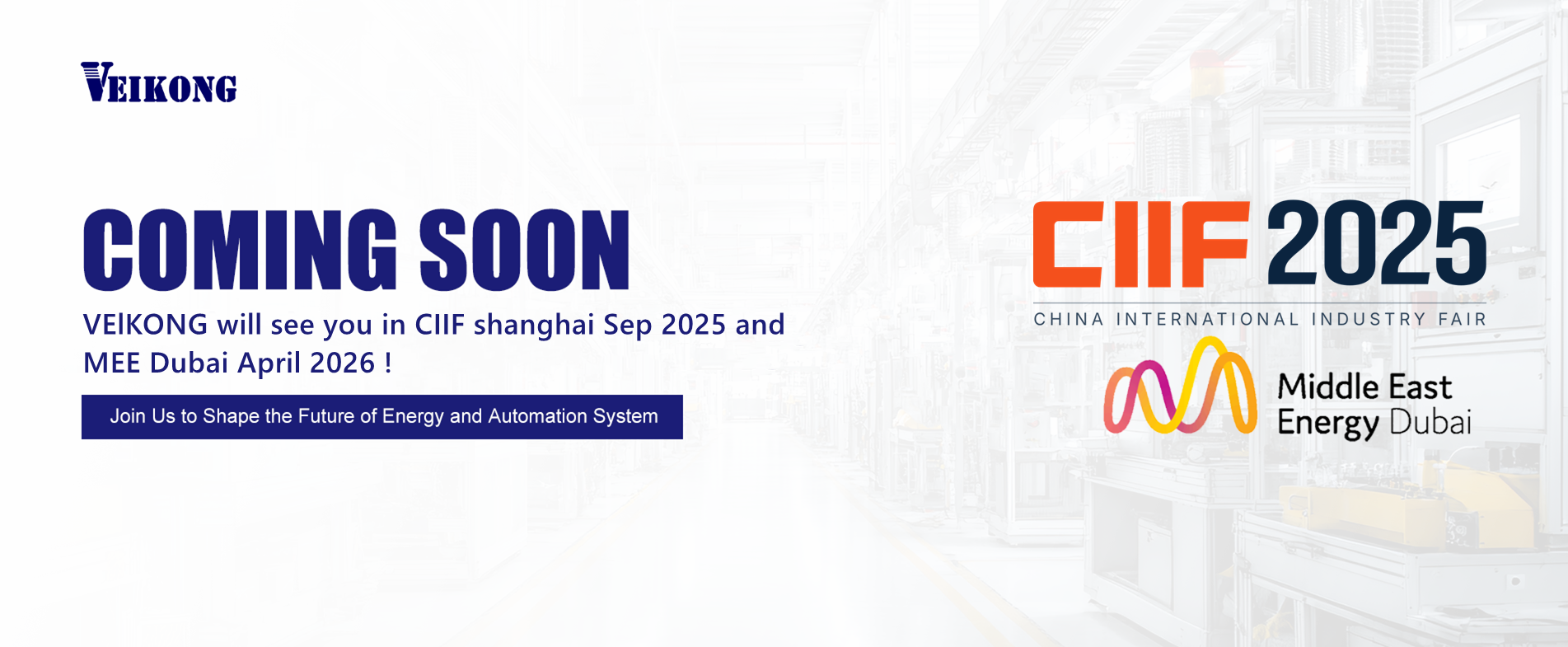
VEIKONG Announces Rescheduling of Middle East Energy Dubai 2026 VEIKONG Announces Rescheduling of Middle East Energy Dubai 2026 Dubai, UAE Due to the ongoing conflicts and unstable situation in the Middle East, the organizers of the Middle East Energy Dubai 2026 exhibition have officially announced that the event will be rescheduled. The exhibition will now take place from September 1st to 3rd, 2026, at the Dubai World Trade Centre.   VEIKONG, a seasoned Chinese manufacturer specializing in industrial automation and power conversion, confirms its participation on the new dates. We will still be located at Booth H7.C37, ready to welcome attendees, distributors, and industry partners from across the region.   What to Expect in September   While the dates have changed, our excitement for meeting you in Dubai has only grown. Looking ahead to September, we look forward to sharing **more new products and solutions** with everyone. Our R&D team has been working on several exciting updates, and the rescheduled exhibition gives us the opportunity to bring even more innovations to showcase—products designed to address the evolving needs of the Middle East's industrial and infrastructure sectors.   What We'll Be Showcasing   Visitors to our booth can still explore our core lineup:   - Industrial AC Drives – Advanced control technology for optimized motor performance and energy efficiency - Servo Drive Systems – Precision motion control for packaging, textile, and automation applications - Solar Pump Inverters – Renewable energy solutions ideal for agricultural irrigation and remote water supply projects - Smart Automation Solutions – Integrated systems enabling remote monitoring and centralized control   Why VEIKONG?   With over 10 years of experience in the industrial automation sector, VEIKONG has built a solid reputation for reliability and innovation. We believe in practical solutions that solve real-world problems, backed by rigorous testing and dedicated customer support.   Mark Your Calendar   - New Dates: September 1–3, 2026 - Location: Dubai World Trade Centre - Booth:H7.C37   We understand that schedule changes can be inconvenient, but we truly look forward to connecting with you in September—and sharing what's new. Our team will be ready to discuss how VEIKONG's solutions can address your operational challenges, whether you're looking to reduce energy costs, improve system reliability, or upgrade aging equipment.   For inquiries or to schedule a meeting during the rescheduled show, please contact us directly.   About VEIKONG: VEIKONG is a Chinese manufacturer specializing in general-purpose inverters, servo drives, and automation solutions. With over 10 years of industry experience, we are dedicated to providing reliable, innovative products that help our customers work smarter and more efficiently.   Stay tuned for further updates as we approach the new dates.
2026-03-05 15:23:21 More >
Welcome to send the inquiry
Please communicate your requirements for products through the online communication form we will reply with faster quatiation in Email and mobile
We keep working online, get in touch.
+86 139 2373 6332 (WhatsApp)
Terry.lee@veikong.com
4F, Building 5, Dongluyang Industrial ,Park, No. 4, Tengfeng 4th Road, Fuyong Phoenix Third, Industrial Zone, Baoan District, Shenzhen China